EcoFarm 2025 was a remarkable, not-to-be-missed gathering of people interested in all aspects of building healthy food and farming systems. This year’s sessions put a spotlight on research to help farmers improve soil health and ecological complexity that can help reduce or eliminate chemical inputs on farms.

The conference began with a day on Practical Whole Farm Solutions for Pest Management Practitioners and Growers. Drs. Miguel Altieri and Hans Herren opened with agroecology to meet the needs of a growing global population, emphasizing the importance of not using chemicals. A dozen more speakers discussed practical insights. Dr. Margaret Lloyd and Gerald Davis focused on soil health to minimize soil pest issues. Gerry’s decades of experience transitioning chemically treated farms for Cal-Organic and his current organic farming experience have resulted in confident testimony about how quickly soil can turn around by feeding the microbes that enliven soil. Alyssum habitat for predators of lettuce aphids headlined Kim Horton’s talk. Dr. Matt Grieshop and Gina Bella Colfer laid out what we may and may not expect from low-risk fungicide and insecticide products. Using robots for weed management was followed by Jessica Vaughan, a trainer in whole farm scouting. Dr. David Headrick wrapped the day on the necessity for proactive pest control action thresholds in organic systems.
The next outstanding talks were called Microbial Matters: Understanding Soil Fungal and Bacterial Communities in Annual Systems featuring Drs. Jennifer Pett-Ridge and Aidee Guzman. Dr. Jennifer Pett-Ridge dove deep into the microbial world. Using Lawrence Livermore National Laboratory’s cutting-edge mass spectrometry and isotope tracing tools, she bridges the Lab’s research on carbon drawdown for national security with insights on soil-building. She stressed the plant’s need for endophytic fungi to inhabit growing root tips. She is finding that the soil microbiome includes viruses on the outside of fungal hyphae that appear to be contributing to plant resistance and resilience. This was a new layer of understanding of soil microbiology for many of us.
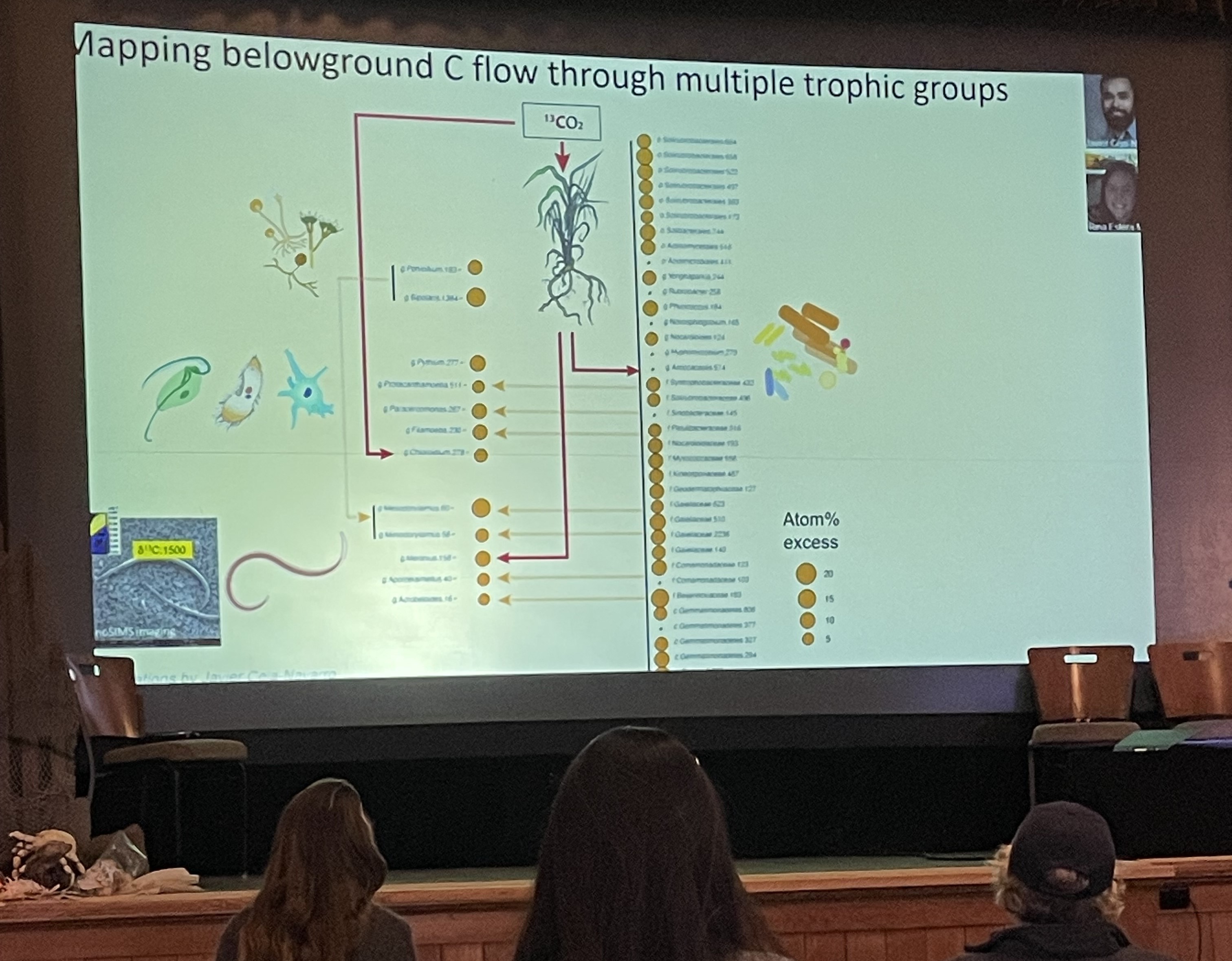
Dr. Aidee Guzman explained how water works in the soil foodweb. She shared a “buyer-beware” slide of approximately 20 microbial and biostimulant products that, in her analysis, did not contain what was advertised. Her take-home was a version of ‘build it and they will come’. The enthusiasm of these researchers should inspire and empower farmers wanting to maximize nutrient cycling, soil organic matter and resilience against climate stressors.
Lessons in Interconnectedness from Leading Researchers
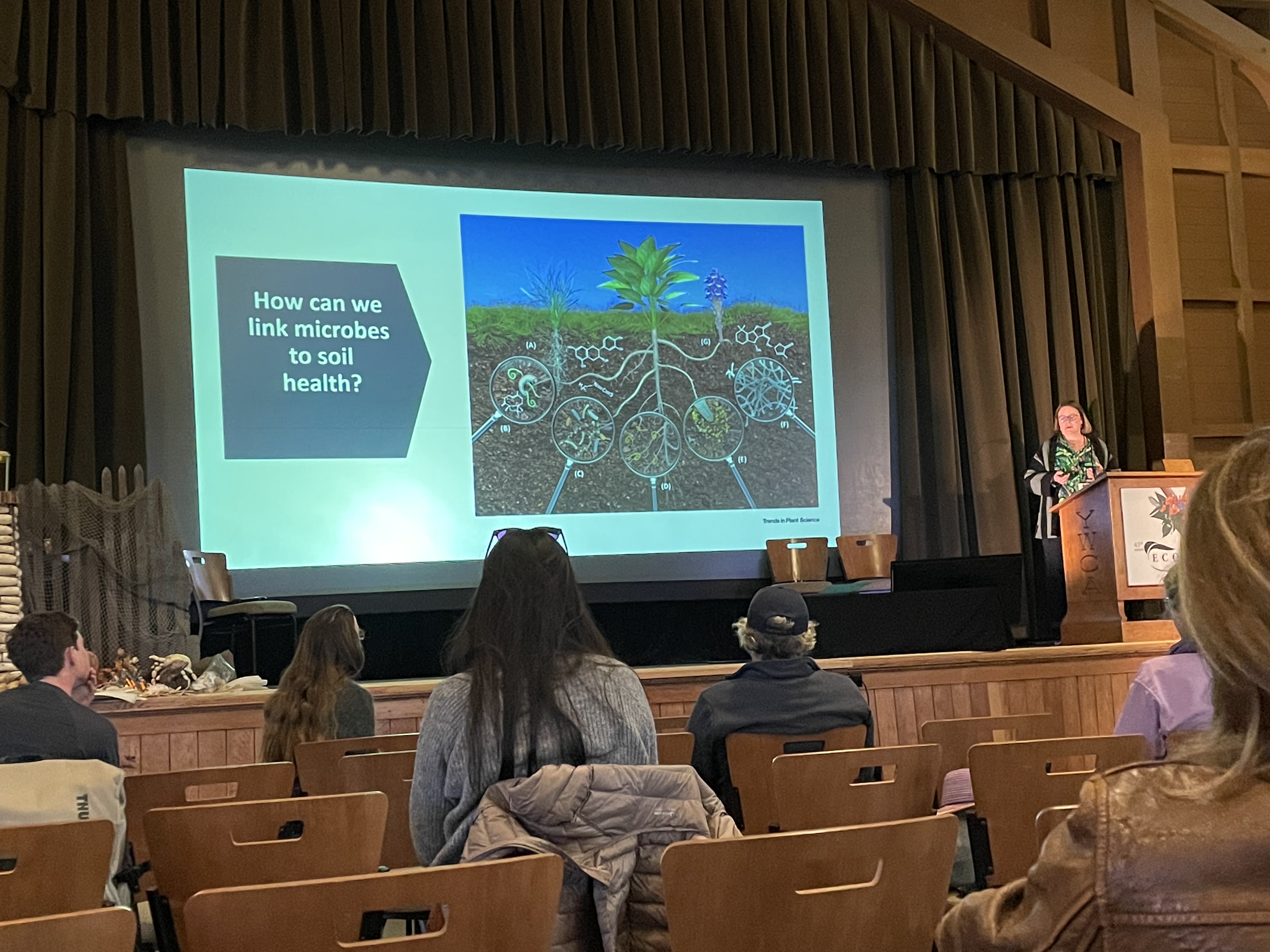
This year’s conference was notable for the number of sessions with researchers illuminating the interconnectedness of soil, plants, and ecosystems. They framed their work broadly to help us grasp the power of complexity in healthy farming systems:
- Amélie Gaudin (UC Davis, Agroecology) highlighted how cropping systems can be reimagined to prioritize resilience and biodiversity, fostering sustainability at every level of production.
- Louise Jackson (UC Davis, Botanist, Emerita) shared decades of insights on the interaction between plants and soil ecosystems, offering farmers pathways to reduce reliance on external inputs.
- William Snyder (University of Georgia, Entomology/Ecology) explored the role of mostly above-ground ecological pest and natural enemy dynamics.
- Eric Brennan (USDA ARS Organic Row Crops Research) shared practical, research-backed methods for enhancing organic row crop production. His popular YouTube channel is a valuable resource.
Whole Systems Thinkers: 1981 and 2025
Whole systems thinking was given new breadth and depth for me this year. I found myself reflecting on how whole systems was the topic of the only guest speaker at the first EcoFarm gathering in 1981 by my father Everett “Deke” Dietrick. He was invited by young farmers who wanted to learn how to prevent pests by protecting the natural enemies. Deke was well-grounded in accurate, precise observation of nature on farms, having done biocontrol research for 12 years. Through the 1980’s up until a few years ago, he was among very few scientists coming to EcoFarm to talk about biological pest control, a topic farmers have not been taught. The profitable marketing of chemicals has flooded available channels with biased or incomplete, highly persuasive, information about toxic pesticides. Biological control requires a new paradigm from what farmers learn everywhere else and it requires new researchers in a learning mode to be effective with what they study and teach.
It was a pleasure to meet Dr. Elizabeth Rowen at the Seed Swap, a new member of the UC Riverside Entomology Department faculty where my father did research from 1947 to 1960. Her prior work on biological control, soil ecology, dung beetles, and soil-plant-insect interactions aligns with the needs of transitioning farmers. She isn’t the only UCR new-hire looking at ecology and plant-insect communities. This is quite a welcome sign!
Building on Common Objectives
What we love about the EcoFarm Conference is the social culture and abundance of opportunities for intentional and serendipitous networking. But this year was the added richness of so many researchers and experienced practitioners converging to network with farmers of diverse backgrounds.

When farmers learn practices informed by cutting-edge science they gain confidence that they can reduce inputs and achieve outcomes for productivity and profitability. Exceptional researchers added to the spirit of this year’s EcoFarm, the collective deep desire to learn to farm better. In an extraordinary three days we learn, find connections, and gather inspiration for our work toward healthy farming systems, and eat delicious organic food contributed by organic farmers.
—Jan Dietrick
 The Bug Farm
0 Responses to “The EcoFarm Conference: Converging to Learn and Grow Healthy Food”