Posts Tagged 'Lacewing'

Mini Lacewing Cards Part of Biocontrol Tool Kit for Gardeners

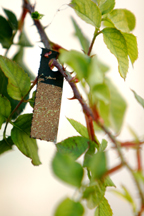
in_lacewing_02_tabMany gardeners think ‘ladybugs’ when they want to go after plant pests. When I have a chance, I try to pitch the benefits of green lacewing instead. Especially from late spring through early fall, lacewing eggs on cards are, in my experience, more reliable and versatile.

Convergent lady beetles (ladybugs) that are so popular prefer an aphid diet and migrate over large distances. They aren’t as interested as lacewing larvae are in a mixed diet that can include small caterpillars, scale crawlers, psyllids, mealybug, whitefly, in fact, just about any soft-bodied insect, mite or egg they run into.

A big feature of lacewing eggs is that they can develop in transit without harm. Buying ladybugs through the mail can be disappointing because they don’t travel very well. Most of the year when there are only stored ladybugs we can’t even guarantee that they will all be alive if they travel more than one day. Sometimes they make it, sometimes not. Hence, we recommend overnight service for ladybugs and resulting shipping costs can be extreme.

Lacewing eggs, on the other hand, are safe in transit while they are incubating. If they are traveling for three days, time enough to get those hungry larvae out on the prowl. A card of 1,000 lacewing eggs is a good amount for a yard with a few rosebushes and trees and some beds of flowers and vegetables. We encourage gardeners to put out lacewing two or three times during the warm season. They are more likely to colonize a yard that has flowers blooming throughout the season, providing nectar for the adult lacewing.

Because lacewing eggs can be shipped by ground or 3-day service, they can be combined with heavier items to economize on freight charges. A mini lacewing card costing $14.00 can be combined with a quart of Gourmet Liquid Ant Bait ($13.50) to meet Rincon-Vitova’s $25 minimum order. If you don’t have any dispensers for the ant bait and don’t want to bother with homemade ones, or if the cost of the AntPro ($26.00) is a barrier, add a pair of Ants-No-More dispensers for $7.50.

If ants aren’t going to be converging on your lacewing cards and cleaning the eggs off of them, then you can go to the next level with a combination with a mini lacewing card and a tray of 250 Aphidoletes for long-term aphid control. If caterpillars are a greater problem than aphids, add the mini-Trichogramma card for $16.00, understanding that they only attack the eggs laid by moths before they hatch into caterpillars. If powdery mildew plagues your garden later in summer, get a quart of Defensor to meet the minimum order with a final installment of lacewing eggs. Beneficial habitat seed mixes and quarts of orange oil or neem oil are other items to acquire with a shipment of lacewing eggs to build a basic toolkit for natural pest control.
Lacewing Marathoners

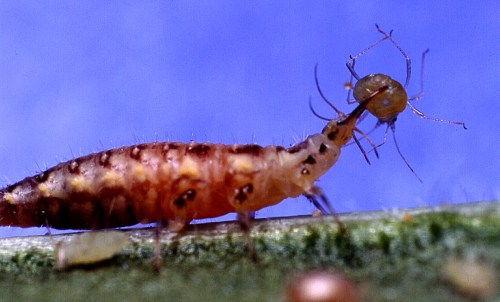
Lacewing larvae feeding on Aphid (Photo © Rincon Vitova Insectaries, Inc.)

Lacewing larvae feeding on Aphid (Photo © Rincon Vitova Insectaries, Inc.)

An efficient green lacewing larva might consume 350 aphids, 11,200 spider mites or 3,780 scale crawlers! They are good at cleaning up eggs and young larvae of many beetles and caterpillars, mealybugs, whiteflies, thrips, leafhoppers and more without wasting time eating the whole thing. They drink the juice and toss away the exoskeleton terminating the prey before moving on. They compete in endurance as well, walking seven miles as larvae. Launch these hungry long-distance runners in pest hotspots.

To sustain these general predators, first control ants by baiting their runs or turn mounds inside out. Then cultivate habitat for beneficials. Corn stalks and sunflowers when shaken at dusk in the peak of bloom will send lacewing fluttering overhead. Borders of alfalfa and oilseed Brassicas, Beneficial Blend or Insecta-Flora seed mixes support lacewing and other natural enemies.

For more info, check out our Lacewing Bulletin on at rinconvitova.com.

This article originally appeared in our Biocontrol Beat Winter 2008 Newsletter.

Photo Series: Lacewing Larvae Units

We’re starting a series of photo posts here at The Bug Farm. Every few weeks, we’ll be putting up some slices of life with quotes and helpful tips from the Rincon Vitova Team. The captions might be a bit formal, but we’re working on a system to have some slide shows which will make it all the better. Stay tuned!

Resident entomologist Ron Whitehurst inspects a Lacewing Larvae Unit for larvae size and distribution at Rincon Vitova Insectaries in Ventura, Calif., on Wednesday, October 17, 2008. “They start out as an egg about 1/30th of an inch and are 5/8th inch when full grown,” explains Whitehurst. Using syringe like pincers to inject digestive enzymes and liquefy their prey, the lacewing larvae “can become effective predators for any soft bodied insects.”

Kyra Ankenbruck and Ron Whitehurst drop moth eggs into the lacewing larvae units in the assembly room at Rincon Vitova Insectaries in Ventura, Calif., on Wednesday, October 17, 2008. The eggs act as a food source during transit. “They’ll have enough food while en route to end users plus they will eat any other lacewing larvae in the cell. [The customer gets] whoever wins.” Ankenbruck says with a smile. Lacewing larvae are voracious predators resorting to cannibalism if there is no other prey.

Jan Dietrick demonstrates how to check the larvae by tapping the unit above white paper. Each unit is filled 115% to ensure each of the 500 cells will have a larva. “Our standard is to overfill the units,” Dietrick explains. “You have to tap the back really hard, because the little larvae may hold onto the inside of the cells.” This same method is used for in-field release of the larvae on infested foliage.

Stacks of Lacewing Larvae Units stand behind the glue board in the assembly room at Rincon Vitova Insectaries in Ventura, Calif., on Wednesday, October 17, 2008. The glue glob on the board has grown layer by layer as a paint roller is used to glue the organdy covers on. Kyra Ankenbruck encountered the glue board in May 2006. “It wasn’t much smaller than now,” Ankenbruck comments.

Kyra Ankenbruck waters down the floor of the Lacewing Larvae Unit incubation room at Rincon Vitova Insectaries in Ventura, Calif., on Friday, November 14, 2008. In dry weather, watering the floor keeps the high humidity the larvae need. “You wouldn’t believe how many we’ve lost when the Santa Anas [hot California winds], blow in,” says Ankenbruck.

For more info on Lacewings and their larvae, check out Rincon Vitova’s Lacewing Bulliten.

All Images copyright: Bryce Yukio Adolphson © 2008 and may not be reused without express permission.


Categories

Archives


Design a site like this with WordPress.com
Get started