Archive Page 7

Lacewing Marathoners

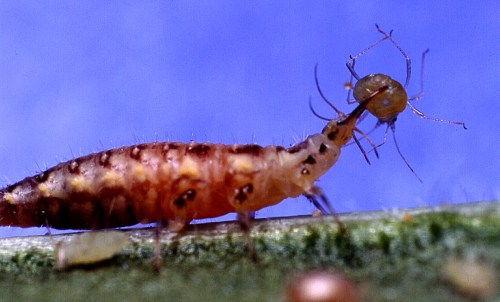
Lacewing larvae feeding on Aphid (Photo © Rincon Vitova Insectaries, Inc.)

Lacewing larvae feeding on Aphid (Photo © Rincon Vitova Insectaries, Inc.)

An efficient green lacewing larva might consume 350 aphids, 11,200 spider mites or 3,780 scale crawlers! They are good at cleaning up eggs and young larvae of many beetles and caterpillars, mealybugs, whiteflies, thrips, leafhoppers and more without wasting time eating the whole thing. They drink the juice and toss away the exoskeleton terminating the prey before moving on. They compete in endurance as well, walking seven miles as larvae. Launch these hungry long-distance runners in pest hotspots.

To sustain these general predators, first control ants by baiting their runs or turn mounds inside out. Then cultivate habitat for beneficials. Corn stalks and sunflowers when shaken at dusk in the peak of bloom will send lacewing fluttering overhead. Borders of alfalfa and oilseed Brassicas, Beneficial Blend or Insecta-Flora seed mixes support lacewing and other natural enemies.

For more info, check out our Lacewing Bulletin on at rinconvitova.com.

This article originally appeared in our Biocontrol Beat Winter 2008 Newsletter.

Use “Ant Trees” and Scale Hotspots to Grow Lindorus

Releasing Lindorus beetles on a mandarin tree for citrus scale control.

Releasing Lindorus beetles on a mandarin tree for citrus scale control.

Ant trees are what we call trees that ants pick out and work over more than most of the trees in the area so that they become chronic hotspots for homopteran and other pests including scale pests. Take advantage of a scale-infested ant tree by creating a barrier for the ants (see future posts about ant management) and release on the scale. They will produce Lindorus for the whole grove for the season and grow there if they don’t freeze or get disrupted by pesticides. You are unlikely to catch them in the act, but you can tell they’re working by the way they rip up the hard scale covers leaving raggedy edges where they got access to their prey. Green lacewing larvae leave similar signs but not as ragged.

Releases of Lindorus are especially valuable in a biological control programs against citrus red and yellow scale, and purple scale. You cannot afford not to do this when surplus beetles are available at deep discounts. Backgrounders about scale IPM programs are described at: IPM.ucdavis for both Red and Yellow and Purple Scale. Note that the University researchers writing these guidelines refer to Lindorus as Rhyzobius lopanthae. They are similar but distinct genera.

Red Scale on Mandarin (Photo by Dan Papacek)

Red Scale on Mandarin (Photo by Dan Papacek)

We especially appreciate Dan Papacek’s work in citrus. His excellent biocontrol tips and photos like this one can be found at bugsforbugs.com.

Florida wax scale on Indian Hawthorns could not be controlled with pesticides, but a report at U of Florida’s site includes Lindorus in an effective program. Check it out here.

Pseudaulacaspis pentagona white peach scale is also a good food for Lindorus. A classic report in the Florida Entomological Society (F.A. Collins and W. H. Whitcomb, 1975). In a more recent report in the same journal, the deleterious effect of “soft pesticides” on Lindorus. We are surprised that, “At one-half the field rate, R. lophanthae [Lindorus] had 43% mortality with insecticidal soap, 63% mortality with imidacloprid, and 46% mortality with fish oil. …the soap and oil were the least toxic of all pesticides tested.” See the full report here.

Organic: what’s in a name? OMRI vs. WSDA vs. NOP

The Organic Materials Review Institute (OMRI) reviews applications from companies that want a third-party verification that their product is suitable for use in organic production, processing, or handling according to the USDA National Organic Program (NOP) guidelines. OMRI listing is voluntary and not appearing on the OMRI list doesn’t necessarily mean that the product is not suitable for organic farming. For more information on OMRI listing, see omri.org.

The Washington State Department of Agriculture (WSDA) also reviews materials and lists ones that they find acceptable. WSDA fee schedule is lower than OMRI, so you may see products listed WSDA Organic.

Producers can self certify that their products meet NOP organic standards. Basically if all the ingredients are from a natural source, the product is NOP. Some artificial chemicals are also acceptable under NOP standards. There are a few products that are natural that are not NOP – for example, strychnine and nicotine. For more information on what is and isn’t allowed by the NOP, refer to the USDA website.

I am in the process of updating Rincon-Vitova Insectaries product descriptions to show whether the product is acceptable for organic use and if it is OMRI or WSDA certified, NOP acceptable, or Natural-Not Regulated (the designation for beneficial insects, microbes or nematodes with no restricted additives).

Day to Day: Wildfires!

From left, Jan, Ron and Duke position themselves to take in the fire.

With all the wildfires in California, we thought we’d post our own little slice of life.

A small hillside fire broke out approximately two miles west of the Rincon-Vitova Insectaries (RVI) around 4:45pm on Tuesday, October 22, 2008. While the late day skeleton crew clicked away at computer monitors, Kyra and Gabe had left early and called in from the road. “You could see the fire from the [RVI] driveway,” Kyra explains. “It looked really close, but driving towards it we realized just how far it was.”

“It was the perspective. At first we thought we might have to evacuate,” said Gabe thinking back on the fire. “We joked about picking which DVDs to leave behind.”

The fire’s distance from the insectaries didn’t ease everyone’s mind. Duke lives nearby and was initially worried his house would be threatened, but it didn’t take long to notice the winds were blowing the opposite direction. “I did make a call to check, though” he said.

About five years ago, Duke’s neighborhood was evacuated during a hillside fire emergency. “…the authorities were pounding on the door and my girlfriend was trying to grab the cat and go. The cat, though, was not compliant.” So she grabbed a pillowcase, threw the cat in, and jumped into the car. “It’s kind of a funny story now,” Duke concludes.

When asked if he was worried about the fire’s proximity, Ron shook his head no. “I used to live at the base of that hill 6 years ago. Conditions in the area are ripe. It’s a reminder to be prepared. Fire is part of the ecology and learning to live with it and having contingency plans is essential.” Ron went on to describe priority boxes or even fire wells to store information below ground.

“It’s about what’s important. We’d shut down the server and grab the basic computer units. If we had more time we’d take the [insect] cages with all the mother cultures. We could take a few trays of [fly] pupae, but if we didn’t get back in three days we’d have a fly problem,” Ron laughs.

In the end, the fire burned approximately 5 acres, accrued no property damage and the unnamed hill stands with a black eye to the north. If there was any common thread felt here at the insectary, it was the realization of choice and priority. Insects may be small, but not everything can fit in a pillowcase.

For more info, check out the Ventura County Star article.

*Second Image: Kyra snapped this with her cell phone on the way home.

Photo Series: Lacewing Larvae Units

We’re starting a series of photo posts here at The Bug Farm. Every few weeks, we’ll be putting up some slices of life with quotes and helpful tips from the Rincon Vitova Team. The captions might be a bit formal, but we’re working on a system to have some slide shows which will make it all the better. Stay tuned!

Resident entomologist Ron Whitehurst inspects a Lacewing Larvae Unit for larvae size and distribution at Rincon Vitova Insectaries in Ventura, Calif., on Wednesday, October 17, 2008. “They start out as an egg about 1/30th of an inch and are 5/8th inch when full grown,” explains Whitehurst. Using syringe like pincers to inject digestive enzymes and liquefy their prey, the lacewing larvae “can become effective predators for any soft bodied insects.”

Kyra Ankenbruck and Ron Whitehurst drop moth eggs into the lacewing larvae units in the assembly room at Rincon Vitova Insectaries in Ventura, Calif., on Wednesday, October 17, 2008. The eggs act as a food source during transit. “They’ll have enough food while en route to end users plus they will eat any other lacewing larvae in the cell. [The customer gets] whoever wins.” Ankenbruck says with a smile. Lacewing larvae are voracious predators resorting to cannibalism if there is no other prey.

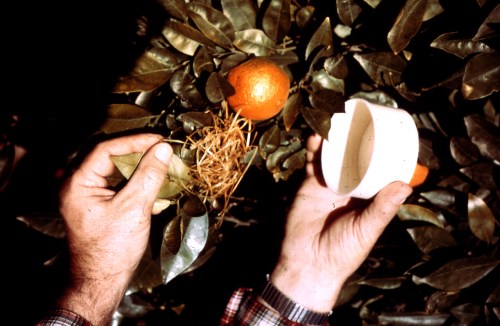
Jan Dietrick demonstrates how to check the larvae by tapping the unit above white paper. Each unit is filled 115% to ensure each of the 500 cells will have a larva. “Our standard is to overfill the units,” Dietrick explains. “You have to tap the back really hard, because the little larvae may hold onto the inside of the cells.” This same method is used for in-field release of the larvae on infested foliage.

Stacks of Lacewing Larvae Units stand behind the glue board in the assembly room at Rincon Vitova Insectaries in Ventura, Calif., on Wednesday, October 17, 2008. The glue glob on the board has grown layer by layer as a paint roller is used to glue the organdy covers on. Kyra Ankenbruck encountered the glue board in May 2006. “It wasn’t much smaller than now,” Ankenbruck comments.

Kyra Ankenbruck waters down the floor of the Lacewing Larvae Unit incubation room at Rincon Vitova Insectaries in Ventura, Calif., on Friday, November 14, 2008. In dry weather, watering the floor keeps the high humidity the larvae need. “You wouldn’t believe how many we’ve lost when the Santa Anas [hot California winds], blow in,” says Ankenbruck.

For more info on Lacewings and their larvae, check out Rincon Vitova’s Lacewing Bulliten.

All Images copyright: Bryce Yukio Adolphson © 2008 and may not be reused without express permission.
Categories

Archives


Design a site like this with WordPress.com
Get started