Archive Page 4

We Don’t Need GMO Cotton

This is a story about why we do not need genetically engineered cotton. GMO cotton has bacterial genes inserted into the cotton plant genome with the “on-switch” gene permanently turned on so every cell of the cotton plant continuously produces pesticide. Bt cotton produces 10,000 times the amount of Bt toxin that would be sprayed on the crop.

I know something about pest control in cotton. My entomologist/applied insect ecologist Dad, Everett (Deke) Dietrick, had me learn to drive in cotton fields. I dropped him on one end of a field and picked him up at the other end so he could monitor the insect ecology through the field. He did research at the University of California on biological pest control. He quit the University because the pesticide companies pressured the University to make sure nothing relevant was done or published about biocontrol. He set up an insectary business — growing a tiny wasp that kills cotton bollworm eggs. He was successful. Cotton growers in Coachella and Imperial Valley’s stopped spraying pesticides and sales of pesticides went down.

Scientists from the Soviet Union heard about his success. He had an open door policy and they came to visit. The Soviets learned and improved on Deke’s biological control program and applied it in a string of 80 insectaries throughout the cotton producing region covering six Central Asian countries. A couple decades later I was invited by the World Bank and by Mercy Corps to go to Turkmenistan and Uzbekistan to help the people who took over those insectaries to privatize them. I took this photo in a biofactory in Turkmenistan where they were growing Habrabracon hebetor as a second line of defense for cotton bollworm to back up the Trichogramma releases.

Image

I saw that they knew what they were doing and the system worked great, just like it did in Coachella and Imperial Valleys 30years earlier before the pesticide companies helped the pink bollworm move into the area (pesticide sales went back up). Bayer pesticide company sales reps in Turkmenistan were pushing pyrethroid pesticides. The pest control experts knew that would cause terrible secondary pest outbreaks and get them on the pesticide treadmill. They knew pesticides would mess things up. Their focus was on sales numbers verses helping the farmers.

The Soviets proved in a huge area of central Asia, what my father had proved earlier–that it is possible to manage all pests of cotton, including cotton bollworm and tobacco budworm, in those two regions without pesticides. Meanwhile we watched as genetically engineered cotton was introduced with the Bt toxin engineered into the DNA of the plant. We knew that it is absolutely not necessary. Bt cotton was not created to solve an agricultural problem or bring a better technology. The best technology, natural biological control, was known and systematically destroyed. Bt cotton was created solely to increase profits for Monsanto.

Farmers have been and are being denied access to knowledge about cost-effective methods because pesticide companies literally burned the books on biocontrol. Monsanto and friends (that bought up all the seed so they can engineer the genomes and patent them) profit from pushing Bt seed on farmers that don’t return benefits. They control the universities and much of the farm press. Natural methods aren’t patentable, and do not provide a profit margin that allows us to do competitive marketing. Farmers need a strong desire to transition off pesticides when they don’t really have strong support from the universities. Farmers who are in a learning mode can do it.

Farmers and consumers: stop falling for the biotech lie that society needs the GMO seeds they are manipulating and patenting. Since government regulators are in biotech’s pocket, all we can do is reduce our use of what they have to sell. Stop buying GMO cotton – buy organic cotton, hemp, linen, silk, and wool or other fibers coming on the market. There is the thrift shop and creative ways to recycle fibers, like Patagonia’s Synchilla from soda bottles. With GMOs labeled, eating less GMO food is also going to have an impact. We need to boycott GMOs so we are not supporting the pesticide/GMO seed monopoly and for the sake of our health and the health of our environment.

Jan Dietrick – October 29, 2012

Garden Club of Santa Barbara Visit

This morning we hosted an informational tour of our facilities to the Garden Club of Santa Barbara.  Five stations throughout the bug farm featured Deke’s Five Features of Integrated Pest Management: Releasing Beneficial Insects, Build Beneficial Refuges & Habitats, Monitor Insect Ecology, Integrate Cultural Practices and Use Soft Pesticides & Avoid Toxic Chemicals.  Our sixth station featured a behind the scenes look of production back in Fly Alley.

Winter Rains Bring Spring Flowers

Here at the Bug Farm, the rainy season is in full effect. In places with a mild Mediterranean climate like ours, this is the best time to plant habitat seed mixes. (In areas further north, plant after the danger of frost is past.) The rain makes it easy for the habitat plants to get established, and by the time the spring crops are planted, some of the flowers should already be blooming and doing their part to support a healthy natural enemy complex to protect the new crop.

If you haven’t sown your habitat seeds yet, don’t fret. Keeping the habitat-to-be wet for a couple of weeks before planting will sprout weed seeds to help reduce weed problems later. Be careful not to disturb soil too much when killing the weeds before planting, though. Tilling can bring new weed seeds up to the surface, undoing the weed control benefits of pre-germinating the surface weed seeds. We’ve found that shallowly raking works well to pull up the weed seedlings without revealing too many new seeds.

See our Habitat Seed Mix page for more information on attracting beneficials with habitat plantings, along with a list of seed mixes we carry.

-Alia Tsang, bug farm intern

Ant Control Weather

When the temperature starts dropping it’s time to go on the offensive against ants. Ants are one of the biggest overlooked factors that lead to biological control failures. Many common species “farm” honeydew producing pests, including aphids and mealybugs. They eat and fight off predators, transport pests to new areas, and will even shelter aphids and mealybugs inside their ant mound. Cooler temperatures slow ants down, making them more vulnerable to attack by the vigilant farmer.

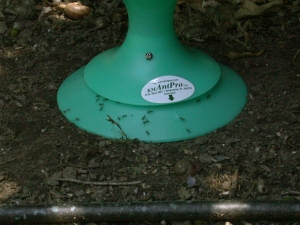
Formica ants on AntPro

Formica ants visiting AntPro bait station

One of the most effective control measures is baiting ants with low toxicity ant baits. We recommend using bait dispensers filled with liquid boric acid baits for sugar feeding ants. Dry granular borate ant baits can also be used. Boric acid won’t kill the foraging ants immediately, letting them bring the poison back to the mound where it can kill the queen. Don’t be alarmed if you don’t see results right away. Because of boric acid’s low toxicity, the same reason it is effective at killing whole mounds, it may take up to a month to see a reduction in ant numbers. Boric acid bait stations can also be used to prevent ant infestations. There are various strategies for bait station placement depending on the kind of ants and the amount and type of area needing protection. If the ants don’t accept the bait, try diluting it or adding more flavor. For example, ants in strawberry crops are more attracted to bait when strawberry juice is mixed in.

Physical disruption of ant nests provides more immediate results. Using a shovel or piece of rebar to break up the ground around the entrance to the colony forces ants that would be foraging to rebuild. If food supplies are low, the ants inside may eat their young. This allows beneficial insects to get to work without interference. Unfortunately, this is only a temporary solution and mounds will need to be repeatedly disturbed to distract the ants from tending to their honeydew source.

Other control measures you can use are nematodes, orange oil drenches, and sticky barriers. Read our Ant Bulletin and our founder Everett J. Dietrick’s paper Argentine Ants Must Be Suppressed for more information on ant control. This fall we’re also offering discounts on ant control supplies.

On an ant control side note, in a field study where they used only sticky barriers for ant control in an organic citrus grove, researchers found more aphids in the trees without ants! Their conclusion was that, as a side effect of excluding ants, they were also protecting the aphids from earwigs. After analyzing the populations of other aphid predators in their grove, they determined that earwigs are one of the main natural controls of aphids in the springtime. Populations of some of the other predators grew in response to growing aphid populations, but not fast enough to control them without the help from the earwigs.

Discussing the study at Rincon-Vitova, we thought of other predators we see a lot in orchards and gardens that would be blocked by sticky barriers – wolf spiders and ground beetles. Releasing aphid predators to back up the naturally occurring ones might have helped the aphid problem in the study grove. Or maybe another method of reducing ant interference without stopping crawling predators from finding the aphids, such as baiting, would have worked better in their case. Aphids can also be blasted off plants with a strong jet of water, which might be a good strategy if you are using sticky barriers. This study is a reminder of how complex these ecological systems are, and that we have to be alert to the unexpected effects our pest control efforts.

(The study mentioned, “Effects of the concurrent exclusion of ants and earwigs on aphid abundance in an organic citrus grove,” was written by Josep Piñol, Xavier Espadaler, Núria Cañellas and Nicolás Pérez and published in the August 2009 issue of BioControl (vol. 54, no. 4, pp. 515-527).)

-Alia Tsang, Bug Farm intern

Neem vs. Fleas

Everyone at Rincon-Vitova loves Duchess, the official Bug Farm dog, especially the fleas. Treating fleas on a bug farm is a little bit complicated, though. The standard treatment is insect growth regulators like Advantage, but using a long lasting insect growth regulator on a dog who wanders around the farm freely, getting pet by everyone, could spell trouble for the bug breeding operations going on.

It’s hard not to feel sympathy for Duchess when she noses her head between your knees, begging for some help scratching, so when I saw neem mentioned as a flea remedy I decided it was time for a product test.

Neem oil comes from the seed of Azadirachta indica, an Indian tree that has been used for pest control and medicine for around 3000 years. One chemical constituent of neem is azadiractin, a natural insect growth regulator. Unlike synthetic insect growth regulators, azadirachtin is completely biodegradable and breaks down in water after about a day. This meant that we could bathe Duchess with neem oil and not worry about someone petting her and contaminating one of our fly parasite or Lindorus production rooms.

I got instructions on making a neem shampoo from Discover Neem. I mixed up some neem oil with shampoo, then Jan and I took Duchess to the employee shower along with Bryce, our multitalented photographer extrordinaire. Duchess didn’t quite like the bath, but she was patient as we tried to saturate her fur with neem shampoo, then rinsed and rubbed her down with some straight neem oil for good measure. We had read that neem oil is also supposed to help flea irritated skin. Finally, we toweled her off and set her free. When she was dry, Duchess’ coat felt much softer and she was scratching a lot less.

One important detail to remember is that neem’s main action is insect growth regulation, which means it can stop immature fleas from maturing and mature fleas from reproducing. It can potentially suffocate insects, however, it doesn’t always kill adult fleas. In warm weather, the flea life cycle from egg to adult can be as short as a week. The best way to stop fleas from bugging your pet is to attack the fleas once every week or two, breaking the flea life cycle. A flea bath once a month is generally not enough to eradicate a flea infestation. In the weeks after Duchess’ bath we got side tracked by other projects and didn’t get to bathe her enough times to completely de-flea her, but the bath she got did cut down her flea population and gave her a break from itching.

I brought some neem oil home and tried it out on my indoor cat, Samus. Since she likes to hang out on my lap and give me her fleas, I had extra incentive to bathe her more regularly. She got 3 neem shampoo treatments, one every two weeks, and her fleas were under control – at least, until she escaped one day and got reinfested. Vaccumming throughly once a week and powdering my carpet with boric acid helped a lot, too.

In any honest discussion of neem I have to mention the smell. Neem oil is powerfully pungent, smelling vaguely but not quite like really strong Thai food. Besides inhibiting insect growth, neem is also repellent to many insects, and it’s not hard to see why. Duchess didn’t seem to mind the smell, but Samus is so offended by it that she ignores me for days when I neem her.

-Alia Tsang, Bug Farm intern


Categories

Archives


Design a site like this with WordPress.com
Get started