Archive for the 'Ecology' Category


Mini Lacewing Cards Part of Biocontrol Tool Kit for Gardeners

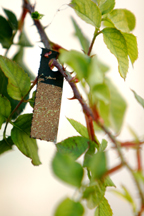
in_lacewing_02_tabMany gardeners think ‘ladybugs’ when they want to go after plant pests. When I have a chance, I try to pitch the benefits of green lacewing instead. Especially from late spring through early fall, lacewing eggs on cards are, in my experience, more reliable and versatile.

Convergent lady beetles (ladybugs) that are so popular prefer an aphid diet and migrate over large distances. They aren’t as interested as lacewing larvae are in a mixed diet that can include small caterpillars, scale crawlers, psyllids, mealybug, whitefly, in fact, just about any soft-bodied insect, mite or egg they run into.

A big feature of lacewing eggs is that they can develop in transit without harm. Buying ladybugs through the mail can be disappointing because they don’t travel very well. Most of the year when there are only stored ladybugs we can’t even guarantee that they will all be alive if they travel more than one day. Sometimes they make it, sometimes not. Hence, we recommend overnight service for ladybugs and resulting shipping costs can be extreme.

Lacewing eggs, on the other hand, are safe in transit while they are incubating. If they are traveling for three days, time enough to get those hungry larvae out on the prowl. A card of 1,000 lacewing eggs is a good amount for a yard with a few rosebushes and trees and some beds of flowers and vegetables. We encourage gardeners to put out lacewing two or three times during the warm season. They are more likely to colonize a yard that has flowers blooming throughout the season, providing nectar for the adult lacewing.

Because lacewing eggs can be shipped by ground or 3-day service, they can be combined with heavier items to economize on freight charges. A mini lacewing card costing $14.00 can be combined with a quart of Gourmet Liquid Ant Bait ($13.50) to meet Rincon-Vitova’s $25 minimum order. If you don’t have any dispensers for the ant bait and don’t want to bother with homemade ones, or if the cost of the AntPro ($26.00) is a barrier, add a pair of Ants-No-More dispensers for $7.50.

If ants aren’t going to be converging on your lacewing cards and cleaning the eggs off of them, then you can go to the next level with a combination with a mini lacewing card and a tray of 250 Aphidoletes for long-term aphid control. If caterpillars are a greater problem than aphids, add the mini-Trichogramma card for $16.00, understanding that they only attack the eggs laid by moths before they hatch into caterpillars. If powdery mildew plagues your garden later in summer, get a quart of Defensor to meet the minimum order with a final installment of lacewing eggs. Beneficial habitat seed mixes and quarts of orange oil or neem oil are other items to acquire with a shipment of lacewing eggs to build a basic toolkit for natural pest control.


AntPro Professional

Ant colonies often aid and protect pests like aphids, whitefly, thrips, and psyllids, because these insects leave behind a consumable nutritive substance called honeydew. Sometimes these invasive or pest-ants can be controlled through mechanical disruption of their trails or nests, with physical barriers, or with sticky resin products like Tanglefoot® or Stikem™. However, excessive and problematic ant populations in horticultural or institutional areas may require the additional use of ant baits and traps. That’s where Ken Kupfer, inventor of Ant Pro®, comes in.

An expert in Ant Control, Ken Kupfer brought an informative presentation and update to the RVI staff recently. Ken covered a wealth of information about ant control, ant behaviors, varying ant species, and current ant control success-stories and dilemmas within the industry of agriculture.

Updating the staff on farmers, growers, institutions, and households worldwide that are currently relying upon the documented, reliably successful, long-term ant control provided by AntPro, Ken displayed the AntPro model: a durable polypropylene liquid ant bait gravity dispenser with a screw-on platform specially designed to hold up to 20 oz of liquid ant bait, while preventing evaporation, flooding, dilution or tampering and protecting non-target insects

Ken presented pictures, maps and success stories from California vineyards to international hotels, where the use of the AntPro has reduced the need for toxic chemical control.

The RVI staff listened intently and followed-up on Ken with questions. We wanted to understand the product to be able to serve customers better.  Ken’s statistics were fascinating; for instance, did you know that there are over 200 ant types in California or that only eight percent of the ants from a typical colony do the foraging work (that means we’re not even seeing 90% of an invading colony!).

Ken was certainly a pro—an AntPro—and an informative and welcome visitor to RVI.  More about AntPro

Everett J. “Deke” Dietrick 1920 – 2008

Everett "Deke" Dietrick

Everett "Deke" Dietrick

Our founding entomologist Everett “Deke” Dietrick died on December 23 at age 88. For over 40 years he mentored many who went on to build successful careers and businesses promoting biocontrol and sustainable agriculture. He did biocontrol research for the University of California, quit when the funding ran out (with a family of five small children including me), and began selling advice as well as growing and selling good bugs. He pioneered both the practice of ecologically based pest management and the insectary industry helping people at all stages on the path away from CCC (conventional chemical control) towards BC by NE (biological control by natural enemies).

Sometimes called the “Father of Commercial Biocontrol”, Deke inspired field advisors to identify markets and insectary teams working for Rincon-Vitova Insectaries, Inc. to innovate mass production systems for beneficials. The goal was often to jumpstart the predators and parasites on vulnerable farms in transition and sometimes to combat a key pest. However, in many situations the main value of the beneficials was to keep farmers from killing them with pesticides. By including releases with monitoring and forecasting, he helped many farmers in over 50 crops in many countries get off of the ‘pesticide treadmill’. He helped entrepreneurs to sell biocontrol in Central America and the Mexican government to establish its network of insectaries. How his work inspired the development of the Soviet biofactories in the Amu-Darya cotton belt is a story in itself. He started D-Vac Company as a separate break-even family business to provide an international scientific standard for sampling arthropods and a tool for applied insect ecologists.

Highly regarded not just by biocontrol researchers and a counter-culture movement of farmers rediscovering organic methods, he was also honored by professionals in the Association of Applied IPM Ecologists that he helped found, and by business people in the Association of Natural Bio-Control Producers. The latter serves the industry that Deke encouraged through decades of sharing of insights and encouragement and watching employees learn, leave and start their own businesses. The insectary business was an economically independent outlet for demonstrating the value of biocontrol. Dietrick saw the Fillmore Insectary, a regional cooperative, as a more sustainable model for providing biocontrol resources to farmers.

Deke sweeping for insects 1993

Deke sweep sampling to monitor beneficial and pest insect populations, 1993

_
Unlike Robert van den Bosch who published an exposé The Pesticide Conspiracy and Don Dahlston who spoke at public hearings against the malathion bait sprays for Medfly, Dietrick kept a lower profile, concerned about risking an attack on the business. He did spend hours with activists, teaching them enough to ask penetrating questions and speak out. “They were burning the books on biocontrol” was his description of the powerful influence of the pesticide industry. He said that he did what he did because there was nobody else who could do it. He also maintained that he only did things that were fun. Deke’s memoirs (to be published) tell about the mentors who prepared him for this role and the challenges he faced. More by and about him is available at dietrick obituary at rinconvitova.com.

Wearing his trademark white canvas hat shading his twinkling eyes, he was a familiar figure at the Ventura Farmer’s Market and was appreciated by so many around town for his engaging spirit. Contributions in his memory can be sent to the Dietrick Institute for Applied Insect Ecology, PO Box 2506, Ventura, CA 93002 to help edit videos of him teaching in the field. A 501c3 non-profit organization, the institute http://www.dietrick.org offers training in ecologically based pest management in recognition of what a legend he is within our field.

Use “Ant Trees” and Scale Hotspots to Grow Lindorus

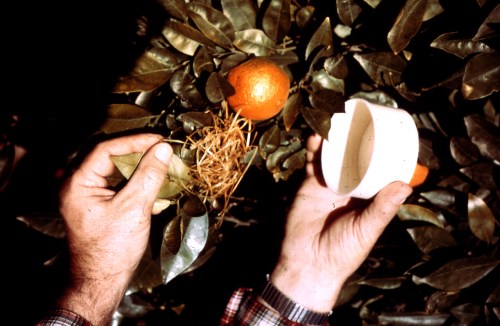
Releasing Lindorus beetles on a mandarin tree for citrus scale control.

Releasing Lindorus beetles on a mandarin tree for citrus scale control.

Ant trees are what we call trees that ants pick out and work over more than most of the trees in the area so that they become chronic hotspots for homopteran and other pests including scale pests. Take advantage of a scale-infested ant tree by creating a barrier for the ants (see future posts about ant management) and release on the scale. They will produce Lindorus for the whole grove for the season and grow there if they don’t freeze or get disrupted by pesticides. You are unlikely to catch them in the act, but you can tell they’re working by the way they rip up the hard scale covers leaving raggedy edges where they got access to their prey. Green lacewing larvae leave similar signs but not as ragged.

Releases of Lindorus are especially valuable in a biological control programs against citrus red and yellow scale, and purple scale. You cannot afford not to do this when surplus beetles are available at deep discounts. Backgrounders about scale IPM programs are described at: IPM.ucdavis for both Red and Yellow and Purple Scale. Note that the University researchers writing these guidelines refer to Lindorus as Rhyzobius lopanthae. They are similar but distinct genera.

Red Scale on Mandarin (Photo by Dan Papacek)

Red Scale on Mandarin (Photo by Dan Papacek)

We especially appreciate Dan Papacek’s work in citrus. His excellent biocontrol tips and photos like this one can be found at bugsforbugs.com.

Florida wax scale on Indian Hawthorns could not be controlled with pesticides, but a report at U of Florida’s site includes Lindorus in an effective program. Check it out here.

Pseudaulacaspis pentagona white peach scale is also a good food for Lindorus. A classic report in the Florida Entomological Society (F.A. Collins and W. H. Whitcomb, 1975). In a more recent report in the same journal, the deleterious effect of “soft pesticides” on Lindorus. We are surprised that, “At one-half the field rate, R. lophanthae [Lindorus] had 43% mortality with insecticidal soap, 63% mortality with imidacloprid, and 46% mortality with fish oil. …the soap and oil were the least toxic of all pesticides tested.” See the full report here.

Organic: what’s in a name? OMRI vs. WSDA vs. NOP

The Organic Materials Review Institute (OMRI) reviews applications from companies that want a third-party verification that their product is suitable for use in organic production, processing, or handling according to the USDA National Organic Program (NOP) guidelines. OMRI listing is voluntary and not appearing on the OMRI list doesn’t necessarily mean that the product is not suitable for organic farming. For more information on OMRI listing, see omri.org.

The Washington State Department of Agriculture (WSDA) also reviews materials and lists ones that they find acceptable. WSDA fee schedule is lower than OMRI, so you may see products listed WSDA Organic.

Producers can self certify that their products meet NOP organic standards. Basically if all the ingredients are from a natural source, the product is NOP. Some artificial chemicals are also acceptable under NOP standards. There are a few products that are natural that are not NOP – for example, strychnine and nicotine. For more information on what is and isn’t allowed by the NOP, refer to the USDA website.

I am in the process of updating Rincon-Vitova Insectaries product descriptions to show whether the product is acceptable for organic use and if it is OMRI or WSDA certified, NOP acceptable, or Natural-Not Regulated (the designation for beneficial insects, microbes or nematodes with no restricted additives).


Categories

Archives


Design a site like this with WordPress.com
Get started