Archive Page 4


We Don’t Need GMO Cotton

This is a story about why we do not need genetically engineered cotton. GMO cotton has bacterial genes inserted into the cotton plant genome with the “on-switch” gene permanently turned on so every cell of the cotton plant continuously produces pesticide. Bt cotton produces 10,000 times the amount of Bt toxin that would be sprayed on the crop.

I know something about pest control in cotton. My entomologist/applied insect ecologist Dad, Everett (Deke) Dietrick, had me learn to drive in cotton fields. I dropped him on one end of a field and picked him up at the other end so he could monitor the insect ecology through the field. He did research at the University of California on biological pest control. He quit the University because the pesticide companies pressured the University to make sure nothing relevant was done or published about biocontrol. He set up an insectary business — growing a tiny wasp that kills cotton bollworm eggs. He was successful. Cotton growers in Coachella and Imperial Valley’s stopped spraying pesticides and sales of pesticides went down.

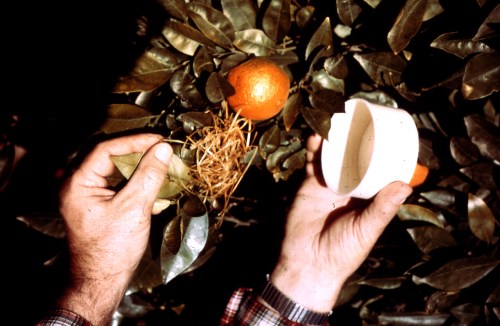
Scientists from the Soviet Union heard about his success. He had an open door policy and they came to visit. The Soviets learned and improved on Deke’s biological control program and applied it in a string of 80 insectaries throughout the cotton producing region covering six Central Asian countries. A couple decades later I was invited by the World Bank and by Mercy Corps to go to Turkmenistan and Uzbekistan to help the people who took over those insectaries to privatize them. I took this photo in a biofactory in Turkmenistan where they were growing Habrabracon hebetor as a second line of defense for cotton bollworm to back up the Trichogramma releases.

Image

I saw that they knew what they were doing and the system worked great, just like it did in Coachella and Imperial Valleys 30years earlier before the pesticide companies helped the pink bollworm move into the area (pesticide sales went back up). Bayer pesticide company sales reps in Turkmenistan were pushing pyrethroid pesticides. The pest control experts knew that would cause terrible secondary pest outbreaks and get them on the pesticide treadmill. They knew pesticides would mess things up. Their focus was on sales numbers verses helping the farmers.

The Soviets proved in a huge area of central Asia, what my father had proved earlier–that it is possible to manage all pests of cotton, including cotton bollworm and tobacco budworm, in those two regions without pesticides. Meanwhile we watched as genetically engineered cotton was introduced with the Bt toxin engineered into the DNA of the plant. We knew that it is absolutely not necessary. Bt cotton was not created to solve an agricultural problem or bring a better technology. The best technology, natural biological control, was known and systematically destroyed. Bt cotton was created solely to increase profits for Monsanto.

Farmers have been and are being denied access to knowledge about cost-effective methods because pesticide companies literally burned the books on biocontrol. Monsanto and friends (that bought up all the seed so they can engineer the genomes and patent them) profit from pushing Bt seed on farmers that don’t return benefits. They control the universities and much of the farm press. Natural methods aren’t patentable, and do not provide a profit margin that allows us to do competitive marketing. Farmers need a strong desire to transition off pesticides when they don’t really have strong support from the universities. Farmers who are in a learning mode can do it.

Farmers and consumers: stop falling for the biotech lie that society needs the GMO seeds they are manipulating and patenting. Since government regulators are in biotech’s pocket, all we can do is reduce our use of what they have to sell. Stop buying GMO cotton – buy organic cotton, hemp, linen, silk, and wool or other fibers coming on the market. There is the thrift shop and creative ways to recycle fibers, like Patagonia’s Synchilla from soda bottles. With GMOs labeled, eating less GMO food is also going to have an impact. We need to boycott GMOs so we are not supporting the pesticide/GMO seed monopoly and for the sake of our health and the health of our environment.

Jan Dietrick – October 29, 2012
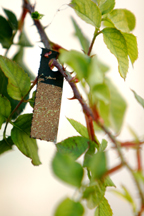
Mini Lacewing Cards Part of Biocontrol Tool Kit for Gardeners

in_lacewing_02_tabMany gardeners think ‘ladybugs’ when they want to go after plant pests. When I have a chance, I try to pitch the benefits of green lacewing instead. Especially from late spring through early fall, lacewing eggs on cards are, in my experience, more reliable and versatile.
Convergent lady beetles (ladybugs) that are so popular prefer an aphid diet and migrate over large distances. They aren’t as interested as lacewing larvae are in a mixed diet that can include small caterpillars, scale crawlers, psyllids, mealybug, whitefly, in fact, just about any soft-bodied insect, mite or egg they run into.

A big feature of lacewing eggs is that they can develop in transit without harm. Buying ladybugs through the mail can be disappointing because they don’t travel very well. Most of the year when there are only stored ladybugs we can’t even guarantee that they will all be alive if they travel more than one day. Sometimes they make it, sometimes not. Hence, we recommend overnight service for ladybugs and resulting shipping costs can be extreme.

Lacewing eggs, on the other hand, are safe in transit while they are incubating. If they are traveling for three days, time enough to get those hungry larvae out on the prowl. A card of 1,000 lacewing eggs is a good amount for a yard with a few rosebushes and trees and some beds of flowers and vegetables. We encourage gardeners to put out lacewing two or three times during the warm season. They are more likely to colonize a yard that has flowers blooming throughout the season, providing nectar for the adult lacewing.

Because lacewing eggs can be shipped by ground or 3-day service, they can be combined with heavier items to economize on freight charges. A mini lacewing card costing $14.00 can be combined with a quart of Gourmet Liquid Ant Bait ($13.50) to meet Rincon-Vitova’s $25 minimum order. If you don’t have any dispensers for the ant bait and don’t want to bother with homemade ones, or if the cost of the AntPro ($26.00) is a barrier, add a pair of Ants-No-More dispensers for $7.50.

If ants aren’t going to be converging on your lacewing cards and cleaning the eggs off of them, then you can go to the next level with a combination with a mini lacewing card and a tray of 250 Aphidoletes for long-term aphid control. If caterpillars are a greater problem than aphids, add the mini-Trichogramma card for $16.00, understanding that they only attack the eggs laid by moths before they hatch into caterpillars. If powdery mildew plagues your garden later in summer, get a quart of Defensor to meet the minimum order with a final installment of lacewing eggs. Beneficial habitat seed mixes and quarts of orange oil or neem oil are other items to acquire with a shipment of lacewing eggs to build a basic toolkit for natural pest control.

Use “Ant Trees” and Scale Hotspots to Grow Lindorus

Releasing Lindorus beetles on a mandarin tree for citrus scale control.

Releasing Lindorus beetles on a mandarin tree for citrus scale control.

Ant trees are what we call trees that ants pick out and work over more than most of the trees in the area so that they become chronic hotspots for homopteran and other pests including scale pests. Take advantage of a scale-infested ant tree by creating a barrier for the ants (see future posts about ant management) and release on the scale. They will produce Lindorus for the whole grove for the season and grow there if they don’t freeze or get disrupted by pesticides. You are unlikely to catch them in the act, but you can tell they’re working by the way they rip up the hard scale covers leaving raggedy edges where they got access to their prey. Green lacewing larvae leave similar signs but not as ragged.

Releases of Lindorus are especially valuable in a biological control programs against citrus red and yellow scale, and purple scale. You cannot afford not to do this when surplus beetles are available at deep discounts. Backgrounders about scale IPM programs are described at: IPM.ucdavis for both Red and Yellow and Purple Scale. Note that the University researchers writing these guidelines refer to Lindorus as Rhyzobius lopanthae. They are similar but distinct genera.

Red Scale on Mandarin (Photo by Dan Papacek)

Red Scale on Mandarin (Photo by Dan Papacek)

We especially appreciate Dan Papacek’s work in citrus. His excellent biocontrol tips and photos like this one can be found at bugsforbugs.com.

Florida wax scale on Indian Hawthorns could not be controlled with pesticides, but a report at U of Florida’s site includes Lindorus in an effective program. Check it out here.

Pseudaulacaspis pentagona white peach scale is also a good food for Lindorus. A classic report in the Florida Entomological Society (F.A. Collins and W. H. Whitcomb, 1975). In a more recent report in the same journal, the deleterious effect of “soft pesticides” on Lindorus. We are surprised that, “At one-half the field rate, R. lophanthae [Lindorus] had 43% mortality with insecticidal soap, 63% mortality with imidacloprid, and 46% mortality with fish oil. …the soap and oil were the least toxic of all pesticides tested.” See the full report here.

Spotlight: Hurricane Ike Visits Shangri La

Recently Kyra was catching up with Jennifer Buckner, Epiphyte Specialist at Shangri La Botanical Gardens and Nature Center on the Texas Gulf Coast (in Orange), after September’s Hurricane Ike. Jennifer explained that preparing for evacuation is very different depending on if a storm is going to bring more wind or more water. The high winds of Hurricane Rita three years ago ripped the roofs off the greenhouses and exposed precious orchids to damaging exposure to the sun. Some have still not recovered. So it was decided to put the plants under the benches to be out of the sun until the staff could get back in.

Holly Hanson, Volunteer Coordinator (and plant caregiver) explains how gut-wrenching it was to drive away. “You don’t know if what’s been done was the best way to protect the plants.” Unfortunately Ike brought water rather than wind, so many precious plants got soaked under the benches and most of the greenhouses are still full of water. She said the staff has been kind of depressed, but sees some benefits from the rebuilding and is celebrating with a Greenhouse Open House on the Saturday before Thanksgiving.

The educational non-profit is faced with massive rebuilding. Not just a leader in ecological pest management, Shangri La was the first project in Texas to achieve LEED Platinum certification! Gary Outenreath, Director of Horticulture, has long been a leader in promoting safe and sustainable pest control, making sure visitors know that no toxic chemicals are used at the facility.

Rincon-Vitova’s Roots

I’m glad we’re setting up a blog for Rincon-Vitova Insectaries, Inc., sharing what we have learned about biological pest control. I want to launch with a post about my dad, Everett J. “Deke” Dietrick, and the circumstances that led him to go into this business.

Entomology had long been the study of dead insects and ways to kill them. During the 1950’s, pesticide companies controlled most research about pest control and researchers were (and often still are) rewarded for playing with statistics to prove that biological insect control doesn’t work well enough. In Deke’s words, “They were burning the books.”

By 1960, Deke had learned enough working on some extensive biocontrol field surveys at the University of California. Seeing no honest biocontrol projects left to work on, he quit. Instead of continuing in the research work, Deke started developing mass-production methods for beneficial insects. He soon was on call for farmers and customers, putting their doubts about predators and parasites to rest. He called himself a “free-enterpriser.”

Rincon-Vitova was always out there, promoting non-chemical methods while every other organization tried to suppress the same knowledge in order to survive. My father said, “You couldn’t get it anywhere else” referring to the field observations and successful experiences of Rincon-Vitova’s pioneering “supervised control” consultants.

Following his inspiration and his open-door policy, national and commercial insectaries were built from Mexico to Pakistan to the former Soviet Union. Today Deke is grateful to see the expanding interest in biological methods. The Association of Natural Bio-Control Producers honored him in 2005 for outstanding contributions to commercial biological control.

Watching my father at work on so many fronts while I was growing up, I understood his mission to show farmers how to control pests without poisons and nothing seemed more meaningful for me than helping him. I am so grateful to be doing what I can to expand and extend his legacy.


Categories

Archives


Design a site like this with WordPress.com
Get started