Archive for September, 2009

Mini Lacewing Cards Part of Biocontrol Tool Kit for Gardeners

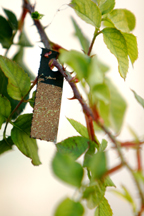
in_lacewing_02_tabMany gardeners think ‘ladybugs’ when they want to go after plant pests. When I have a chance, I try to pitch the benefits of green lacewing instead. Especially from late spring through early fall, lacewing eggs on cards are, in my experience, more reliable and versatile.

Convergent lady beetles (ladybugs) that are so popular prefer an aphid diet and migrate over large distances. They aren’t as interested as lacewing larvae are in a mixed diet that can include small caterpillars, scale crawlers, psyllids, mealybug, whitefly, in fact, just about any soft-bodied insect, mite or egg they run into.

A big feature of lacewing eggs is that they can develop in transit without harm. Buying ladybugs through the mail can be disappointing because they don’t travel very well. Most of the year when there are only stored ladybugs we can’t even guarantee that they will all be alive if they travel more than one day. Sometimes they make it, sometimes not. Hence, we recommend overnight service for ladybugs and resulting shipping costs can be extreme.

Lacewing eggs, on the other hand, are safe in transit while they are incubating. If they are traveling for three days, time enough to get those hungry larvae out on the prowl. A card of 1,000 lacewing eggs is a good amount for a yard with a few rosebushes and trees and some beds of flowers and vegetables. We encourage gardeners to put out lacewing two or three times during the warm season. They are more likely to colonize a yard that has flowers blooming throughout the season, providing nectar for the adult lacewing.

Because lacewing eggs can be shipped by ground or 3-day service, they can be combined with heavier items to economize on freight charges. A mini lacewing card costing $14.00 can be combined with a quart of Gourmet Liquid Ant Bait ($13.50) to meet Rincon-Vitova’s $25 minimum order. If you don’t have any dispensers for the ant bait and don’t want to bother with homemade ones, or if the cost of the AntPro ($26.00) is a barrier, add a pair of Ants-No-More dispensers for $7.50.

If ants aren’t going to be converging on your lacewing cards and cleaning the eggs off of them, then you can go to the next level with a combination with a mini lacewing card and a tray of 250 Aphidoletes for long-term aphid control. If caterpillars are a greater problem than aphids, add the mini-Trichogramma card for $16.00, understanding that they only attack the eggs laid by moths before they hatch into caterpillars. If powdery mildew plagues your garden later in summer, get a quart of Defensor to meet the minimum order with a final installment of lacewing eggs. Beneficial habitat seed mixes and quarts of orange oil or neem oil are other items to acquire with a shipment of lacewing eggs to build a basic toolkit for natural pest control.

Lindorus Kicks Christmas Trees Off Pesticide Treadmill

Lindorus eating pine needle scale

Lindorus eating pine needle scale

After years of spraying more pesticides and achieving less control, many of Ron Evans’ Christmas trees were left unfit to sell because of messy scale infestations. Farming for over 45 years, they began noticing pine needle scale 15 years ago. Scotch pine, red pine and Austrian pine were especially susceptible. In the mid 1990’s they used conventional pesticide spray based on monitoring and treating hot spots. Despite treatments, the scale crawlers spread and all trees with scale were eventually sprayed twice a year.

Within six years Evans reported, “Typically we were spraying all the fields three to four times per year. We tried to follow the recommendations found in pest control literature, but still found ourselves fighting a losing battle. Most of the literature recommends spraying scale when crawlers are present. Scale typically crawls for three days after hatching, and we logged as many as seven hatches the summer of 2000. The logistics of spraying 100,000+ trees in a three day window, three to four or more times per year became more than a nightmare.” Four E’s Trees was burning 1,500-3,000 trees every year that were ruined by scale pests. 

Evans called the University of Illinois Department of Entomology. Among their suggestions was a small black lady beetle Lindorus lopanthae as a scale predator. Ready to try something new, Evans cooperated in a test of Lindorus beetles. He put a small number of Lindorus in a remote patch on his farm during June 2002, while continuing with his conventional program everywhere else. In November, while they were harvesting (with difficulty because of scale damage), he walked back to the remote field, where five months prior he had released the Lindorus beetles and forgotten about them. To his surprise this patch of trees was the only area on the entire farm without a scale infestation!

Four E’s Trees released several thousand Lindorus beetles the following season. According to Evans, “The first year results were amazing. We had entire fields of marketable size trees that we could not sell in the 2002 Christmas season due to excessive infestations of scale. These same fields were scale free, healthy and salable for the 2003 season. In addition to reducing the scale infestations to manageable levels, we spent $3,000 less on pesticides and countless fewer man-hours with the Lindorus beetles than the spray program the previous year.” Lindorus must be released annually when there are enough scale to feed them, which is usually late spring to early summer.

In 2005 Rincon-Vitova Insectaries, recognizing that Four E’s was able to provide valuable technical support to expand the successful use of one of the organisms it grows, offered a dealership to Four E’s Trees to sell Lindorus to the Christmas tree industry. Evans writes and speaks to Christmas tree associations and supplies Lindorus to over 50 growers in 14 states. Four E’s helps customers assess the scope of the problem, the type of scale, the number of beetles needed and timing of release, other cultural practices to produce pest resistant trees, how to distribute the beetles and monitor results. Beetles are shipped overnight to Four E’s customers for them to make the releases. For more information about Lindorus for scale in Christmas trees, write to Ron Evans <FourEsTrees @ aol.com> or call (217) 864-4704 and ask for Ron or Doug.


Categories

Archives


Design a site like this with WordPress.com
Get started